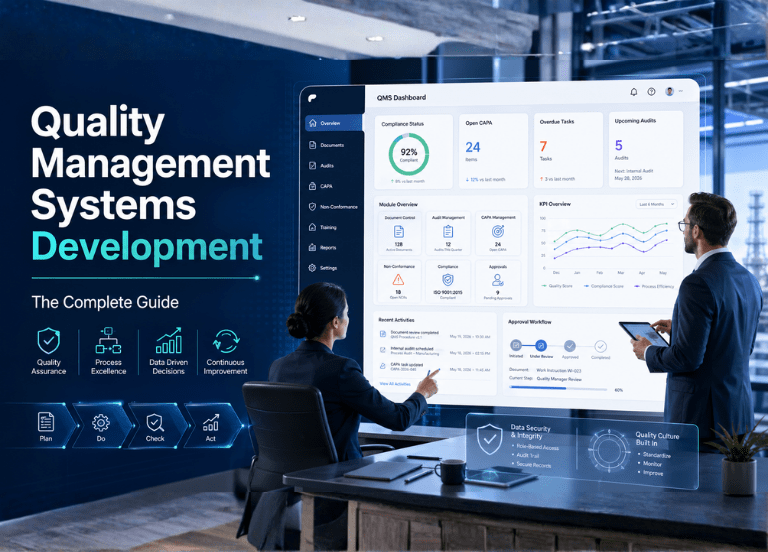
Summary: Quality management systems development is the process of planning, designing, building, and deploying software that manages an organisation’s quality policies, documents, audits, and corrective actions. Patricius IT develops customized QMS systems based on ISO 9001:2015 for regulated industries like pharmaceuticals, manufacturing, and software. This guide goes over the entire development lifecycle in six stages, outlines the most important parts of a QMS, gives planning checklists, and talks about common issues. This quality management systems development approach keeps strategy, compliance, and delivery aligned.
Introduction
Quality management systems development is the planned, structured process of creating, constructing, and putting into use a digital system that controls how a company handles its quality standards, procedures, paperwork, and corrective actions. Patricius IT specializes in custom QMS software for businesses that need systems that fit their industry, regulatory needs, and technology infrastructure.
Whether you’re an operations manager trying to lower defects, a CTO trying to add quality workflows to your current technology stack, a product team trying to speed up release cycles, or a compliance officer getting ready for your next audit, this guide is for you.
In the next few sections, you’ll learn about the most important steps in building a quality management system (QMS), the components that every QMS needs, how to plan your project from the start, and the common pitfalls that even well-funded projects often make. ISO 9001 is a quality management standard that is known around the world. It helps businesses of all sizes and types improve their performance, exceed consumer expectations, and show that they care about quality [1]. It is still the industry standard, which is why Patricius IT builds custom QMS software that is based on ISO 9001 and fits the way your teams function.
What Is Quality Management Systems Development?
The process of creating a quality management system involves designing, building, and deploying a platform that handles an organization’s quality policies, processes, documents, audit trails, and corrective actions all in one place. It’s more than just buying a ready-made tool. True quality management system development means engineering a solution that fits your unique regulatory environment, integrates with your current enterprise systems, and scales with your business.
The ISO 9001:2015 standard is the foundation for all industries to set up their QMS. Over 1 million businesses in more than 170 countries have received certification [2]. More than 1 million businesses in over 170 countries have become certified [2]. ISO 9001 informs you what to manage, but quality management system development determines how your organisation manages it, using software made for the purpose instead of spreadsheets, paper records, or rigid platforms. In practice, quality management system development connects compliance goals with day-to-day workflow design.
Learn More About Our Quality Management System
QMS Solutions by Patricius IT
Custom development vs. off-the-shelf QMS:
| Factor | Custom Development | Off-the-shelf QMS |
|---|---|---|
Flexibility |
Complete control over data architecture, features, and workflows |
Few options for customizing things up |
Integration |
Made to work with your current systems (ERP, CRM, PLM) |
May need expensive middleware or workarounds |
Compliance fit |
Customised to fit your specific regulatory needs |
Generic templates for compliance |
Scalability |
Developed to scale up with your business |
Licensing tiers may slow down growth |
Time to deploy |
For mid-sized organisations, this usually takes 3 to 6 months. |
Faster setup at first, but slower adaptability |
Why Do Businesses Invest in Developing a Quality Management System?
Companies invest in developing a quality management system so they can lower expenses, ensure regulatory compliance, and gain real-time visibility into quality performance. The reasons include strategic, operational, and financial.
Core reasons businesses develop a QMS:
- Regulatory compliance: The FDA, ISO, CE marking, and other comparable groups govern industries that need documented and auditable quality systems. A custom QMS makes sure that these processes are embedded into daily operations.
- Reducing product defects: For the average factory, the cost of poor quality (COPQ) eats up 10% to 30% of their annual income. For world-class facilities, that number is less than 5% [3]. For many manufacturers, costs associated to quality might consume 15% to 20% of their yearly revenue [3].
- Streamlining audit preparation: Centralised audit records, automatic scheduling, and real-time dashboards reduce weeks of preparation before an external audit.
- Centralising documentation: The most common QMS feature that people ask for is document control, which includes versioning, approvals, and access management.
- Automating QA workloads: Automation takes care of manual tracking by automating things like routing CAPAs and sending NCR notifications in real time.
- Real-time quality KPIs: Decision-makers need dashboards, not retrospective reports. A modern QMS gives you real-time information about defect rates, audit results, corrective action timelines, and supplier performance.
The financial case: Based on World Bank data from 33 countries, the Standards Council of Canada states that ISO 9001:2015 certification boosts overall sales by 48.3%. Across all industries, the average return on investment (ROI) is 3:1 within 18 months [4]. Developing a quality management system doesn’t cost very much. It helps to generate revenue.
What Are the Key Stages of Quality Management Systems Development?
The development of quality management systems goes through six stages, from the first step of defining the scope to the last step of continual improvement. To ensure compliance and usability, each step builds on the previous one. The six steps are: A clear quality management systems development roadmap helps every stage stay measurable and practical.
Step 1: Define Quality Objectives and Scope
The first step in every QMS project is to figure out what you need to control and why. Work with key stakeholders (quality leads, department heads, and regulatory officers) to map out current processes, figure out what the regulatory requirements (ISO 9001, FDA 21 CFR Part 11, and industry-specific standards), and set clear quality goals. This step determines the scope of the entire build.
Step 2: Design the QMS Architecture
Plan out the system’s process hierarchy (how quality workflows are connected), module structure (which features like document control, CAPA, and audit management are necessary), and platform choice: building a new platform from scratch or setting up an existing one. Custom development is usually the best long-term value for businesses that need complex integration requirements.
Step 3: Build Core Modules and Workflows
Document control, non-conformance (NCR) management, CAPA workflows, audit management, training and competency tracking, and supplier quality management are all common parts of core modules. There are approval chains, escalation rules, notification triggers, and role-based access controls in each module.
Step 4: Test and Validate the System
Before it can be used, the system must go through three testing phases. User acceptance testing (UAT) makes sure that the requirements are met. Compliance testing checks regulatory obligations. Performance testing ensures real-world volumes are handled. This is when software quality assurance becomes really important. Testing is a must when making a QMS. For this reason, quality management system development should include validation from both quality and technical users.
Step 5: Deploy, Train, and Go Live
A phased rollout, starting with a pilot team or department, lowers risk and boosts confidence within the company. Staff training is critical: even the best system won’t work if people don’t use it. Communication on change management should start before the go-live date and continue after.
Step 6: Measure, Audit, and Continuously Improve
Deployment is not the end of developing quality management systems. After the launch, you need KPI dashboards to keep an eye on how well the system is working, scheduled audits to make sure it is still compliant, and a review cycle to find ways to make it better. This is where a KPI management system integrated into your QMS keeps quality metrics visible and actionable.
How Do You Develop a Quality Management System? Planning Checklist
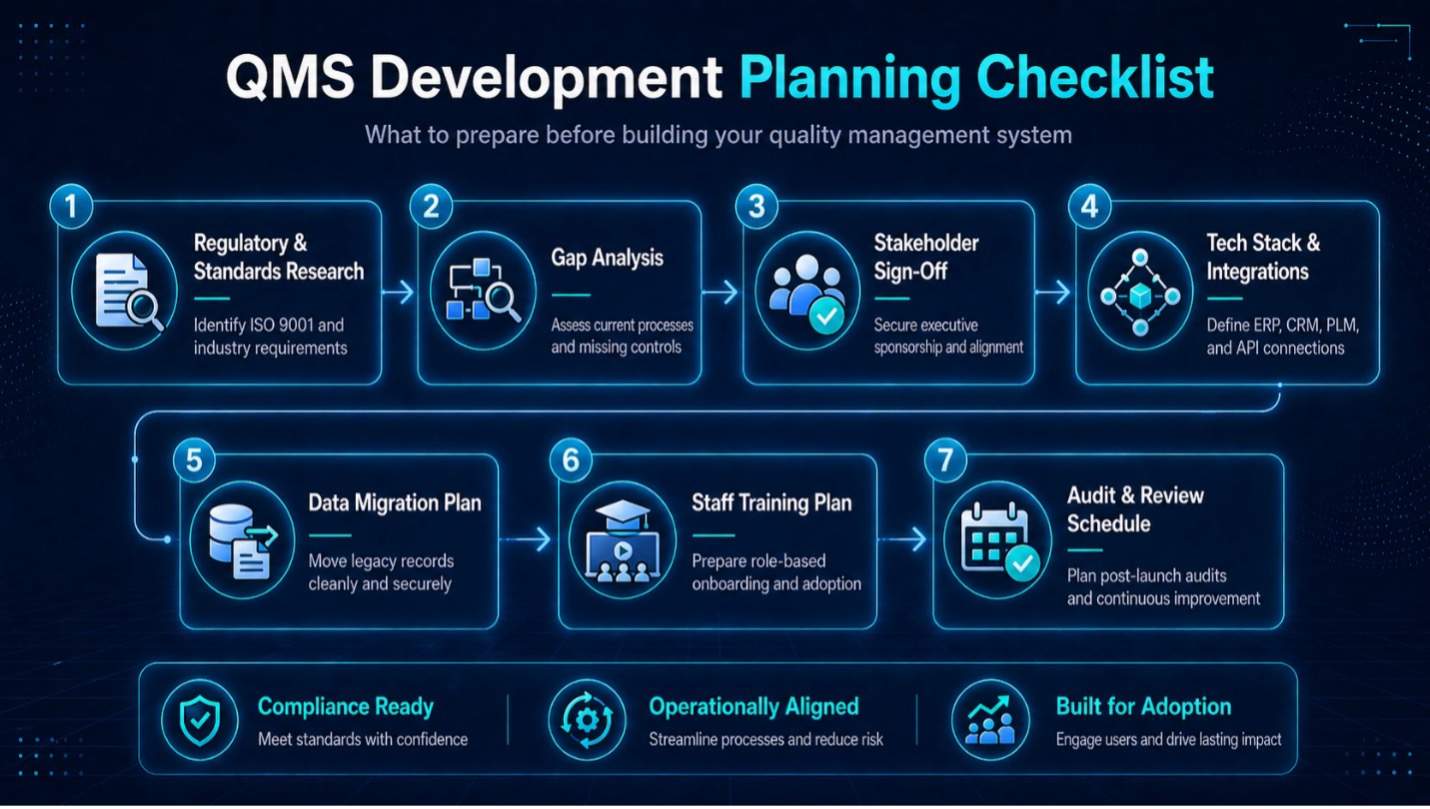
Before writing a single line of code, the best method to create a quality management system is to follow a structured planning checklist. These seven steps set apart QMS projects that are successful from those that don’t get off the ground: It also gives teams a practical view of how to develop a quality management system before development starts.
- Conduct regulatory and standards research: Make a list of every standard that your QMS must follow, such as ISO 9001 and standards that are specific to your industry. This first step clarifies how to develop a quality management system around the right compliance obligations.
- Perform a gap analysis of current quality processes: Note down what is there now and what is missing.
- Get top-down stakeholder sign-off: Executive sponsorship is non-negotiable.
- Define your tech stack and integration points: Find out which systems (ERP, CRM, PLM) the QMS needs to work with.
- Create a data migration plan: The older quality data needs to move seamlessly into the new system.
- Build a staff training plan: Don’t plan a training session that works for everyone; instead, plan for role-based training. Role-based training also supports how to develop a quality management system that people can actually use.
- Set up an audit and review schedule: Set a time and method for evaluating the system when it becomes live.
The two most overlooked steps are data migration planning and post-launch audit scheduling. Organisations spend a lot establishing the system, but they don’t realize how hard it is to migrate historical records. Then they don’t set up the review schedule that is needed to sustain improvement. Planning for what occurs after the launch is just as crucial as planning for what happens before it.
Learn More About Our Quality Management System
QMS Solutions by Patricius IT
What Does a Quality Management System for Software Development Include?
A good quality management system for software development should have features like defect tracking, code review workflows, release compliance gates, automated audit trails, and integration with CI/CD pipelines. It looks very different from a manufacturing QMS since software teams require a solution that fits their development lifecycle, release cadence, and engineering workflows. A quality management system for software development should therefore connect engineering activity with compliance visibility.
Key elements of a QMS for software teams:
- Code review workflows: structured peer review gates integrated into version control
- Defect tracking: linking bugs to root causes, CAPA processes, and release notes
- Release compliance: ensuring every release meets defined quality and regulatory criteria before deployment
- Audit trails: full traceability from requirement to code to test to deployment
ISO/IEC/IEEE 90003:2018 gives guidelines on how to use ISO 9001:2015 in software engineering. It explains the steps needed to make software products and services that meet customer needs and are of high quality [5]. It helps organisations make sure that their software development environment follows ISO 9001 rules [5].
A QMS must work with CI/CD pipelines and agile sprint cycles for software development teams. Quality gates should automatically start in deployment pipelines, not in disconnected manual steps This is where software quality assurance and QMS design come together, and why custom software development expertise is essential for building a system that fits modern engineering workflows A custom quality management system for software development makes these quality gates part of the team’s normal delivery flow.
What Are the Essential Components of a Custom QMS?
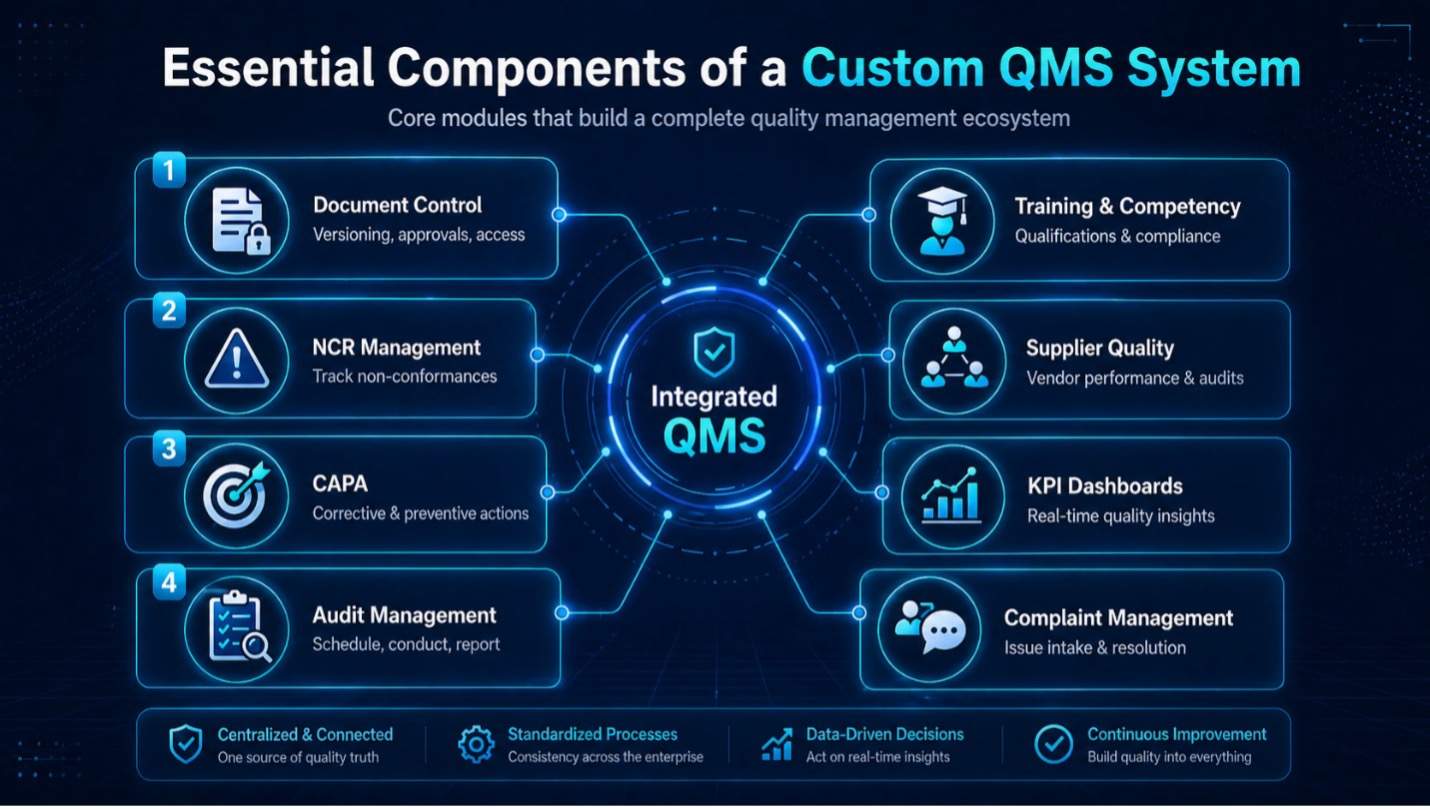
A custom QMS is modular. Each component serves a different purpose in quality management, and when they all work together, they create a closed-loop quality ecosystem. There are eight important parts:
Essential Components of a Custom QMS
A custom QMS is made up of connected modules that manage quality processes from documentation to issue resolution, audits, training, suppliers, KPIs, and customer complaints.
1. Document Control
Manages document versions, approval workflows, controlled distribution, and access permissions for all quality documents.
2. Non-Conformance Management
Helps teams log, track, investigate, and resolve quality failures with complete audit trails.
3. CAPA Management
Provides structured workflows for identifying root causes, implementing corrective actions, and preventing the same issues from happening again.
4. Audit Management
Supports internal and external audits with scheduling, reporting, automated reminders, and finding tracking.
5. Training & Competency
Tracks employee qualifications, certifications, and training completion so only competent personnel handle quality-critical tasks.
6. Supplier Quality Management
Evaluates and monitors vendor performance through supplier scoring, supplier audits, and approved supplier lists.
7. KPI Dashboards
Shows real-time quality metrics, including defect rates, CAPA closure times, audit results, and supplier performance trends.
8. Complaint Management
Manages customer issue intake, investigation, resolution tracking, and trend analysis.
The document management category had the biggest part of the market in 2024, making up 28% of the worldwide quality management software market. This was due to increasing regulatory documentation requirements and digital transformation initiatives.
Patricius IT’s QMS has more than 16 modules that work together to cover all of the above and more. Each module is designed for a specific function, which makes sure that data flows smoothly across document control, NCR resolution, CAPA workflows, and audit management. This module plan keeps quality management system development practical, connected, and easier to scale.
What Are the Common Challenges in QMS Development?
Over-engineering, poor user adoption, integration failures, lack of post-launch iteration, and wrong tech stack selection are the five most prevalent problems that come up when developing a quality management system. This is how to fix each one:
Over-engineering the system: Make sure that scope is based on real compliance needs and operational needs. People don’t use a system that tries to control everything, thus it doesn’t end up regulating anything.
Poor user adoption: Don’t just design for the compliance officer who develops the specification; design for the end user. If field operators and line managers find the system hard to use, they will find ways to go around it, which will ruin the data integrity that the QMS was meant to protect.
Integration failures: Do not plan API connections after the construction; do it prior. During the architecture phase, make a list of all the systems the QMS needs to communicate with (including ERP, document repositories, and HR systems) and plan integrations as top-notch features.
No post-launch iteration plan: From the very first day, plan for quarterly reviews. Quality management systems development is never truly “done”. Processes change, rules change, and feedback from users shows where things can be better. This is why quality management systems development should include a review plan from the first release.
Wrong tech stack: The technology has to work with your existing infrastructure. If your enterprise uses .NET and PostgreSQL, implementing a QMS on a stack that doesn’t work with those two makes maintenance harder and makes it harder to integrate things over time.
What Does Patricius IT's QMS Development Service Include?
Patricius IT designs, builds, and deploys custom quality management systems that are tailored for your industry, your processes, and your compliance needs. Our QMS is fully custom-built.
Technology stack: .NET 9, Angular, and PostgreSQL were chosen because they are fast, can handle a lot of users, and are easy to maintain over time.
What makes Patricius IT different:
- Custom-built vs. off-the-shelf: Full control over the features, integrations, and user experience.
- Industry-specific configurations: Each module is made to fit the needs of a certain industry, such as managing NCRs in manufacturing or CAPA workflows in pharmaceuticals.
- Integrated compliance automation: Automated document control, audit scheduling, and regulatory reporting can cut down on manual work by up to 85%.
- Centralised quality control: Up to 70% of departments and sites have centralised control
- Faster issue resolution: CAPA and NCR resolution times are cut by as much as 50%
Market context: In 2025, the global quality management software market was worth $12.52 billion. By 2034, it is expected to be worth $31.54 billion, with a compound annual growth rate (CAGR) of 10.81% . Companies that invest into developing quality management systems now are in a good position to lead.
Patricius IT also offers additional services, such as our e-invoicing system for regulated document exchange, IT staff augmentation to help you develop more efficiently, and data analytics and reporting for in-depth quality insights.
Learn More About Our Quality Management System
QMS Solutions by Patricius IT
Frequently Asked Quesions
The process of planning, designing, building, and deploying software that handles an organization’s quality policies, processes, documentation, corrective actions, and audit workflows is called quality management systems development. It is developed on standards like ISO 9001:2015 and is customized to meet an organisation’s specific industry and regulatory requirements. Patricius IT develops custom QMS systems using .NET 9, Angular, and PostgreSQL.
Most mid-sized businesses can expect their QMS to be ready in three to six months. The actual length of time will depend on the scope of modules needed, how complicated it is to integrate with existing systems (ERP, CRM, PLM), how many stakeholders are involved, and how many people are working on the project. Industries that are heavily regulated, including pharmaceuticals and medical devices, may need more time for compliance and validation testing. The timeline also depends on how to develop a quality management system with the right scope and validation plan.
With custom QMS development, you have complete control over features, integrations, data architecture, and the user experience. It is ideal for businesses that have complex compliance needs or workflows unique workflows. Off-the-shelf solutions are cheaper and faster to deploy, but they aren’t as flexible, can’t be integrated with other systems as easily, and can need expensive workarounds when needs change. Patricius IT focuses on creating custom software for businesses where off-the-shelf cannot meet requirements.
A quality management system (QMS) for software development usually has features like defect tracking, release compliance gates, code review procedures, automated audit trails, and connection with CI/CD pipelines. ISO/IEC/IEEE 90003:2018 provides guidance to set up a quality management system in the field of software engineering [5]. It does this by making sure that development processes follow the rules of ISO 9001:2015.
The cost of developing a QMS depends on the number of modules, how deeply they are integrated, regulatory requirements, and how much customisation is needed. A basic system with key modules like document control, NCR, and CAPA costs considerably less than a full-featured enterprise QMS with advanced analytics and multi-site deployment. The best way to get an accurate estimate is to discuss your specific requirements with Patricius IT.